October 16, 2012
I’ve seen people talking about a Financial Times article on Twitter over the last few days. It’s a unique insight; a view on game design and game culture from someone very new to games. I recommend reading it. The link is below, and the rest of this blog post gives my reaction.
“Game Theory – What happens when someone who had never played video games is chosen as a judge for some gaming awards?”
I was actually blown away by this, and I think this a major achievement.
I don’t worry a great deal about the “wider cultural acceptance” of videogames. I feel like the share of the population that are gamers is large enough and invested enough that they can feel confidence in it’s worth without outside approval. But yes, the outside view of games is very different to other popular mediums. Most people who don’t regularly read books, visit museums or watch movies still have the understanding that they can create a wide range of emotions, educations and experiences. Many people who never play games do not have that understanding.
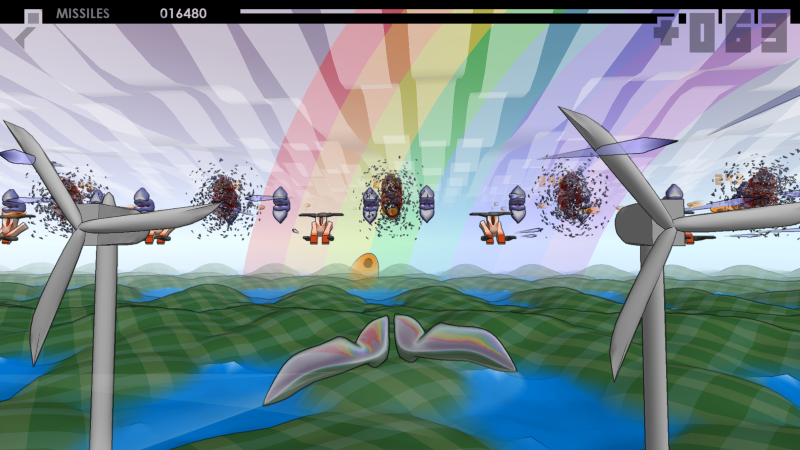
So when a person so far from the traditional video game target-market, approaching games with that background and attitude can come away not just having gained some understanding, but some enjoyment and respect is huge. Not convinced? Try to imagine if this piece had been written in the PS2 era. Remember when “indie” wasn’t a thing, and video games could only find a market through a handful of big publishers who played it safe. When game designers repeatedly failed to pitch any ideas that strayed too far from stagnating genres. In the late nineties there was no platform to promote a game like Proteus, and no support for a game like Journey. Business models for games like this seemed impossible.
![354cpro-613x355[1]](http://www.benbradley.com/blog/wp-content/uploads/2012/10/354cpro-613x3551-300x173.png)
Proteus
Surely the same writer’s reaction to a selection from the late nineties would have been very different. Whether or not
you think there were games of artistic merit then, I think that someone with this attitude and background would not have reacted nearly as positively to the best offerings of those times. I can think of a handful of major reasons for this and some can be spotted in the article itself. It’s not my goal to go into those here, because my point is simply that these are being addressed. That’s great.
When I said “I think this a major achievement”, that doesn’t mean that I think that this article means “wider cultural acceptance” acheived. But the surface is scratched. The major achievement is that there are now games which someone who has these stereotypical negative predispositions can approach and come away from with respect and some positive insights. Obviously we still need a lot more games which do this, and do this better. Maybe we need more platforms like GameCity to set this kind of connection up. Indie games have been around for a while now; sometimes it’s good to remember the background they emerged from every now and then.
February 20, 2012
Dear Esther is a recently released indie “walk-em-up” which originated as a free Half-Life 2 mod. It focuses on story and exploration with no combat. I’ve seen a few online discussions asking whether this constitutes a game. There are some reviews on gaming websites which immediately suggest that it isn’t. I’ve seen these kind of arguments about projects such as Minecraft and Sleep is Death in the past as well.
I’m not about to quote a definition for “game” here.
In the UK in 1999 if you said you were “texting your friend” you would have been some kind of idiot. Your English teacher would have cracked a wooden ruler over your knuckles and told you that you were “composing a text to” because “text” is a noun. A few years later, “text” was added to the Oxford English dictionary as a verb because so many people were using “texting” this way that it had taken on a new meaning in the English langauge. Dictionaries are there to reflect what people mean by words, not to lay down the law.
A review might be right to suggest that Dear Esther doesn’t fit a particular definition of game, but when you scroll down to the comments and see that it’s players “favourite game so far this year” and that they “would recommend the game” it’s the definition which may need updating. Gaming is growing and new genres are appearing. Not all games are going to be competitive or goal driven, but I’m sure the word “game” will get carried along with this movement. Whether something is a game or not will largely be down to the public.
July 3, 2011
I just finished Hexen II. I hadn’t played it before, I literally bought this game just because I loved Quake 1. But I have completed Quake many times and it holds no surprises for me now. Hexen II was developed with the Quake 1 engine, it has similar feel and style but is more RPG based. I thought I’d give it a go.
There was one particular puzzle I’d like to describe for anyone interested in game design…
- There are nine buttons on the floor in a 3×3 square, and you have to press three of them in the right order to proceed.
- There are three possible solutions, which are on a small unmarked plate on a random wall half an hour back in the game.
- Each time you attempt to enter a solution, the ‘correct’ solution is selected randomly from these three possibilities.
- This means it’s possible to try all three solutions in turn and not succeed.
- If you press the buttons in the wrong order, you are teleported back through the level and have to walk for a minute to reach the buttons to retry.
- Also when you are teleported back, the helpful message “Nothing happened…” appears on the screen.
- After you press each button in, you have to stand nearby and wait for about two seconds for the button to rise before stepping onto the next one in the sequence, or this too counts as a failed attempt with the same message.
The only reason I know all of these conditions is because I read two different walkthroughs – neither of the authors of these FAQs were aware of the complete set of rules and mentioned that they were still confused and their descriptions may not be accurate. By figuring out some of these rules and with sheer determination, they had fumbled past this puzzle in order to continue.
![Hexen-II2[1]](http://www.benbradley.com/blog/wp-content/uploads/2011/07/Hexen-II21-300x187.jpg)
Hexen II
This was the worst puzzle in the game but there were a few that came close. In one level I needed to find a spade, and although there was one was in plain sight in the middle of the level, I couldn’t pick it up because it was just a prop – the real one was hidden in a closet. I was also often frustrated by other flaws, such as doorways in the corners of rooms which were completely unlit, making the black doorway indistinguishable from the surrounding black walls. And I discovered that if I stood behind the final boss, he couldn’t see me so just stood there while I shot him in the back.
What did the critics make of Hexen II? The first three reviews I find on Google are MobyGames giving 82%, Gamespot giving 73% and CVG 94%. Fact is, in 1997 flaws like this were acceptable.
Some people say “games aren’t as good as they used to be”. I disagree!… Compare with Portal 2. OK, it’s not an RPG but it’s a first person shooter that tells a story, with lots of puzzles and some combat. And keep in mind that it also had similar review scores. But drop the puzzle I’ve described above into Portal 2 and you’d halve those scores, because design like that is not acceptable today.
I can be nostalgic about old games, but not especially so. I’m not too bothered about riding the cutting edge either. My favourite games are scattered liberally all over the last twenty years. My favourite Mario game is Super Mario Bros 3, but this is largely because I first experienced when it was released. I feel that it’s the best Mario game for it’s time, but that doesn’t make it the best of all time. If someone was new to gaming I’d be more likely to point them to Super Mario Galaxy, and I think they’d find this to be a more enjoyable game.
Graphics, sounds, story telling, control, menus, feedback, and presentation have all improved. People are better at designing games now. Putting light sources over doorways so the player can see them is just one little trick designers have learnt. But it goes further than that – they put the doorways in considered positions, or create architecture that leads the eye towards points of interest, so the player naturally finds their way through a level. They put play testers in front of puzzles and watch how they react, not just to check that they understand what they should be doing, but to see whether the solving the puzzle has made the player feel clever or educated them about the game’s universe.
![portal2-scene[1]](http://www.benbradley.com/blog/wp-content/uploads/2011/07/portal2-scene1-300x187.jpg)
Portal 2
If you look at some sub-par modern games and compare them with those retro games you cherish then things might look bleak today. There are modern design directions I dislike; achievements for doing otherwise illogical tasks, meaningless patronising reward credits, and I’m sick of customising avatars before I start every other game. But I think the average games of the times are better than the average games of past years. New games are designed with the experience of previous iterations. Each generation refines every aspect of game design. The best is yet to come.
June 3, 2011
A lot of indie games use pixel art. I think these are the reasons most commonly cited by observers of the scene:
1) A sense of Nostalgia or a general nod to old games.
2) It’s Simplicity for those with low budgets of money or time.
I think these are sometimes true, but I think there are other equally important reasons:
1) High Definition screens.
Yep I’m really claiming that low-resolution pixel art is popular because of the availibility of high-resolution displays.
There are other ways to make game art that are simple. More classic paint-like tools, vector based tools, scanned drawings. People make pixel art games today because it looks a lot nicer now than it did in it’s day.

Mario wasn’t a pretty baby.
This is Super Mario Bros on an average 80s television. It’s pretty disgusting, and I doubt every gamer of the time figured out that the image was made up of squares. The edges of Mario are highly blurred. The font is high contrast and easier to discern, but in general pixels bled together and pixel art was harder to appreciate.
With modern monitors, not only are individual pixels sharper, but developers are using mutiple screen pixels per artwork pixel, for super sharp definition. With hard edges and a limited colour palette which doesn’t bleed into other colours, pixel art now has a clearer style which is easier to appreciate.
Infact HD is so sharp that developers are breaking down the pixels to apply styles in or around them, as in Appy 1000mg or Arkedo PIXEL!.

Arkedo PIXEL!

Appy 1000mg
2) Art Tools.
The vast majority of 2D art tools use pixels as the smallest element. Zoom in on Windows Paint and you have a brilliant pixel art tool, available on every computer. Had Paint and Photoshop used pentagons as their smallest unit, I reckon we’d see a lot more pentagon based art styles.

Pentagon Based Pattern
These tools do exist but they’re not as popular or accessible. The interface may not be suited to everyone. But even if these tools were everywhere, there’s one more imporant benefit squares have over other shapes:
3) Directional Movement.
You can simply move a pixel based image vertically, horizontally or diagonally by one pixel and it still fits in a grid. This art style has an inherent compatibility with D-pads and arrow keys!
So, modern pixel art looks really nice, it’s easy to create and it just works. Personally I haven’t got bored of seeing it in games yet. But I’d like to see some more tools for indies to create artwork with styles other than squares. In terms of movement, other shapes are only a problem while the entire game is based on the same grid; take that away and images can still broken down to simpler forms. I’d love to make some tools like this one day. If anyone knows of any examples please post in the comments!
March 17, 2011
Since the start of 2011 one game has dominated my downtime over all others; Red Alert 3.
I actually played half of Red Alert 3 a couple of years ago on the Xbox 360, but I didn’t really get into it. Not because of the console controls, which were very well designed and markedly different from the PC version. Just because it wasn’t resonating with me. Right now I struggle to play anything else. The game hasn’t changed, it’s definitely me. And I can tell you why… it’s the way I work…
I can’t remember where, but I once read that people quite often play games which involve exactly the same tasks that their work involves. Work in HR? The Sims gives you people management. Have a list of tasks that you have to check off one by one? That’s pretty much what the enemies in a first-person shooter are. Do you need to be focused or efficient in your job? You might like to hunt the racing line in a driving game when you get home.
Although you might do a certain task all day, there’s something relaxing about doing a thing because you’ve chosen to and not because you need to. And if your work gives you a certain skill, a game which requires that skill will reward you generously for your talent.
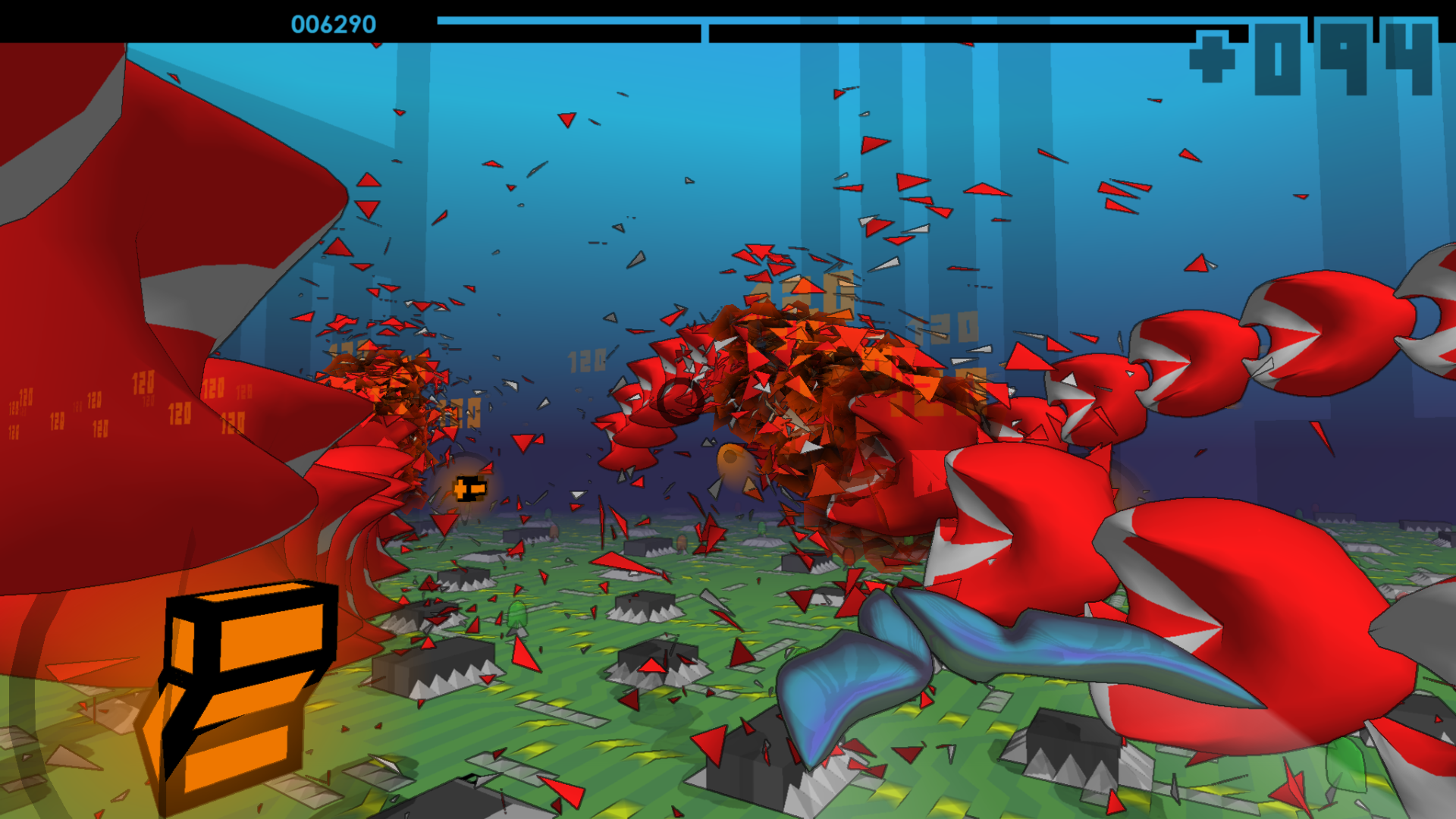
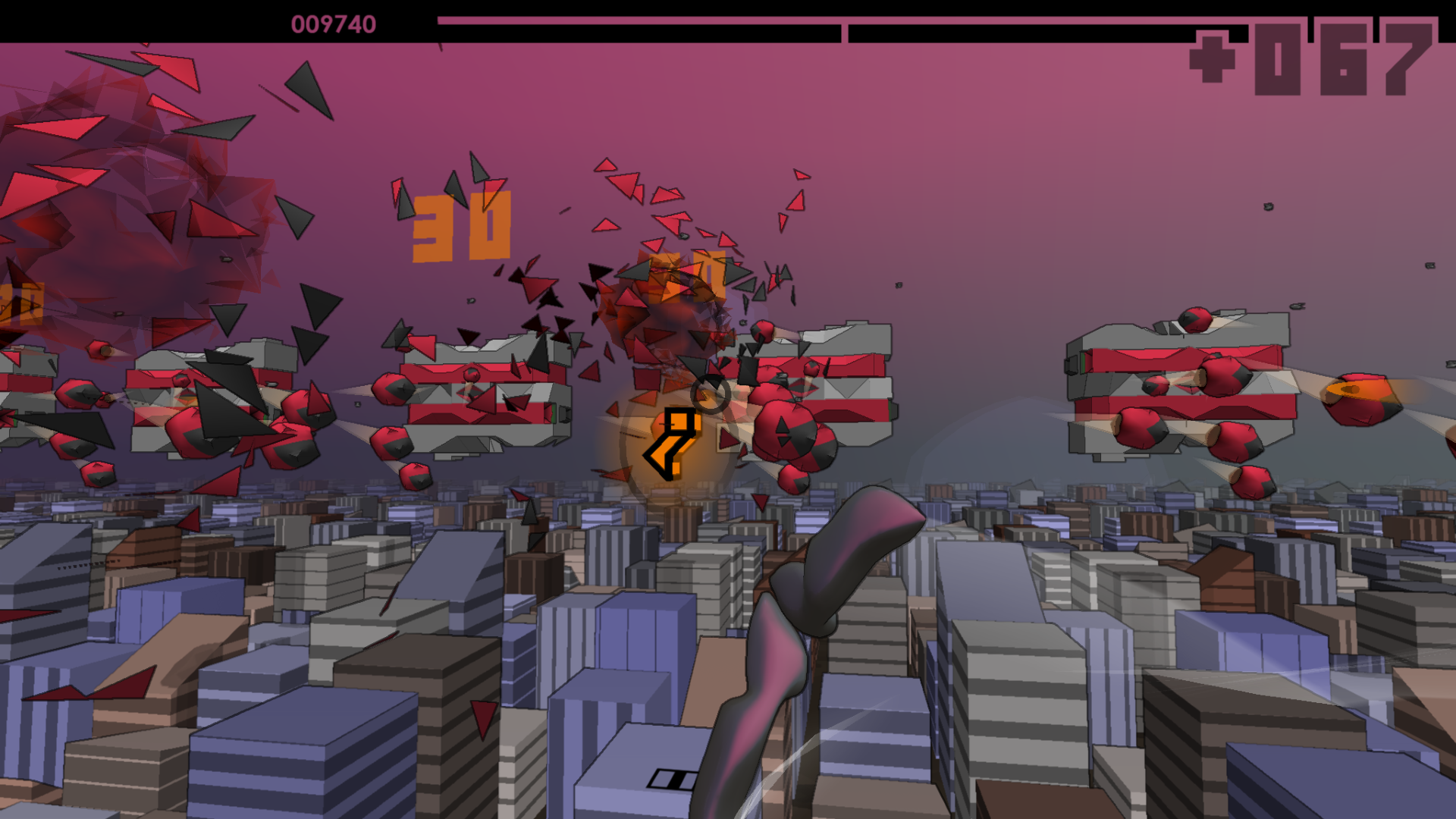
So what about me? Two years back (when Red Alert wasn’t really grabbing me) I was working in a game development team of 30. It was Geometry Wars that held my attention at home. A game where more is happening around you than you can fully understand, and you instead reach success by focusing on what’s presently important to your ship and simply trusting that every enemy will eventually be destroyed. This is much like working on a game in a team. Many other people are changing the game in parallel to you, but you focus on your area of the game with only a minimal knowledge of what others are doing so that you can detect if and when their work will collide with yours.

Geometry Wars.
Nowadays, working independently means I wear all the hats. I control everything, but I have to choose when to strike at certain tasks. How thinly can I spread myself – do I work on multiple tasks at once or do I need to set my focus on some specific problem and make sure it’s destroyed as soon as possible? I look into the future. If there’s a chance to show my game to the public or enter into a competition, then where should I set my priorities to make the most of that situation?

Just Another Day at the Office.
Programming is quite natural to me now. What is new to me is the need to constantly review my progress and make decisions about what to work on, how long I expect things to take, and how to split my free time and work time. I actually review this stuff two or three times a week. My task list is very important to me and it’s very dynamic.
Does your work relate to the games you enjoy the most?