April 27, 2013
For the most part this is a game development blog, and not a blog about my personal life. I guess that’s why I haven’t updated it for several months – the first part of 2013 has seen some big changes in my life that have kept me madly busy.
Being an independent game developer and not releasing games hasn’t been a very profitable business, so I now have a full time job. It’s a programming job but it’s not in games development.
Obviously this slows Substream development down massively. It is now my hobby, my side project. It means more than that to me, but in terms of time spent, that’s the way it’s going to be for a while. There is still a lot to do on the game, and it definitely won’t be out this year. But having invested so much time, money and soul into it gives me huge determination.
Anyways, I’m pretty happy about having some regular income for now. It’s allowing me to do some of things I’ve been delaying for the past three years (usually with the line “when the game’s out….”). For example:
Earlier this month I got married!! :oD The average planning period for a wedding in the UK is probably about eighteen months. Me and my wife put ours together in three, and with very little assistance. This got pretty stressful, and ate up even more of my time. But we followed it up with a relaxing honeymoon in South Korea, which was also amazing.

Wedding Windmills
I hope now I’ll settle into working on the game more in my free time and see how well it progresses.
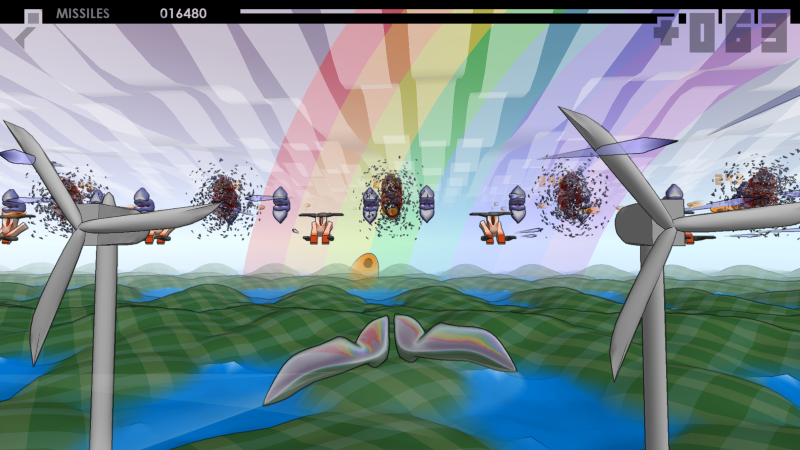
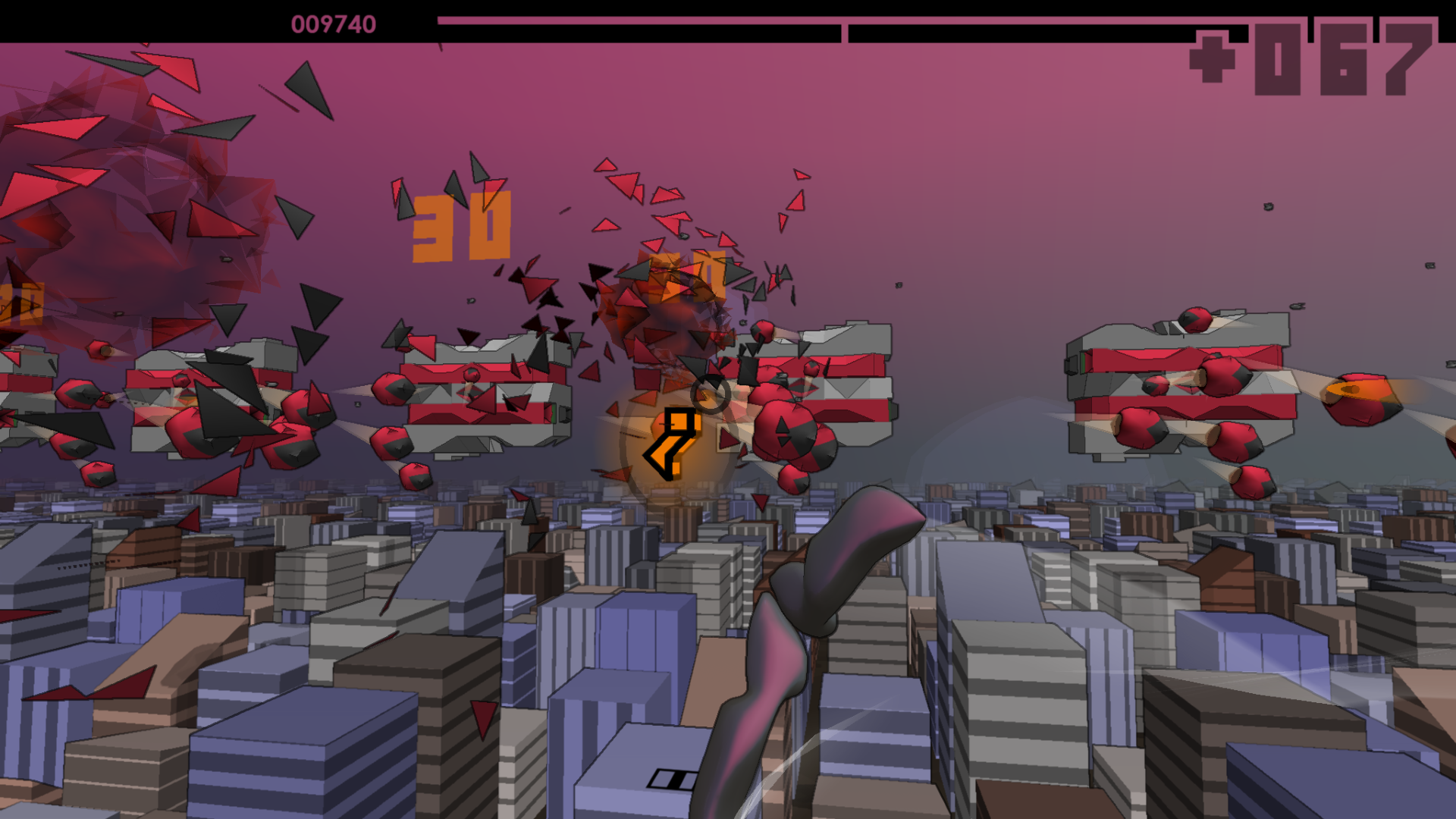
But one last little mention before I go and do that: Substream was at my wedding, on every table. My wife’s also the creative type, and used screen shots of the game in windmill decorations. If any evidence was needed that this project’s still important to me, here it is. ;o)
November 16, 2012
This last month has been a great one for Substream.
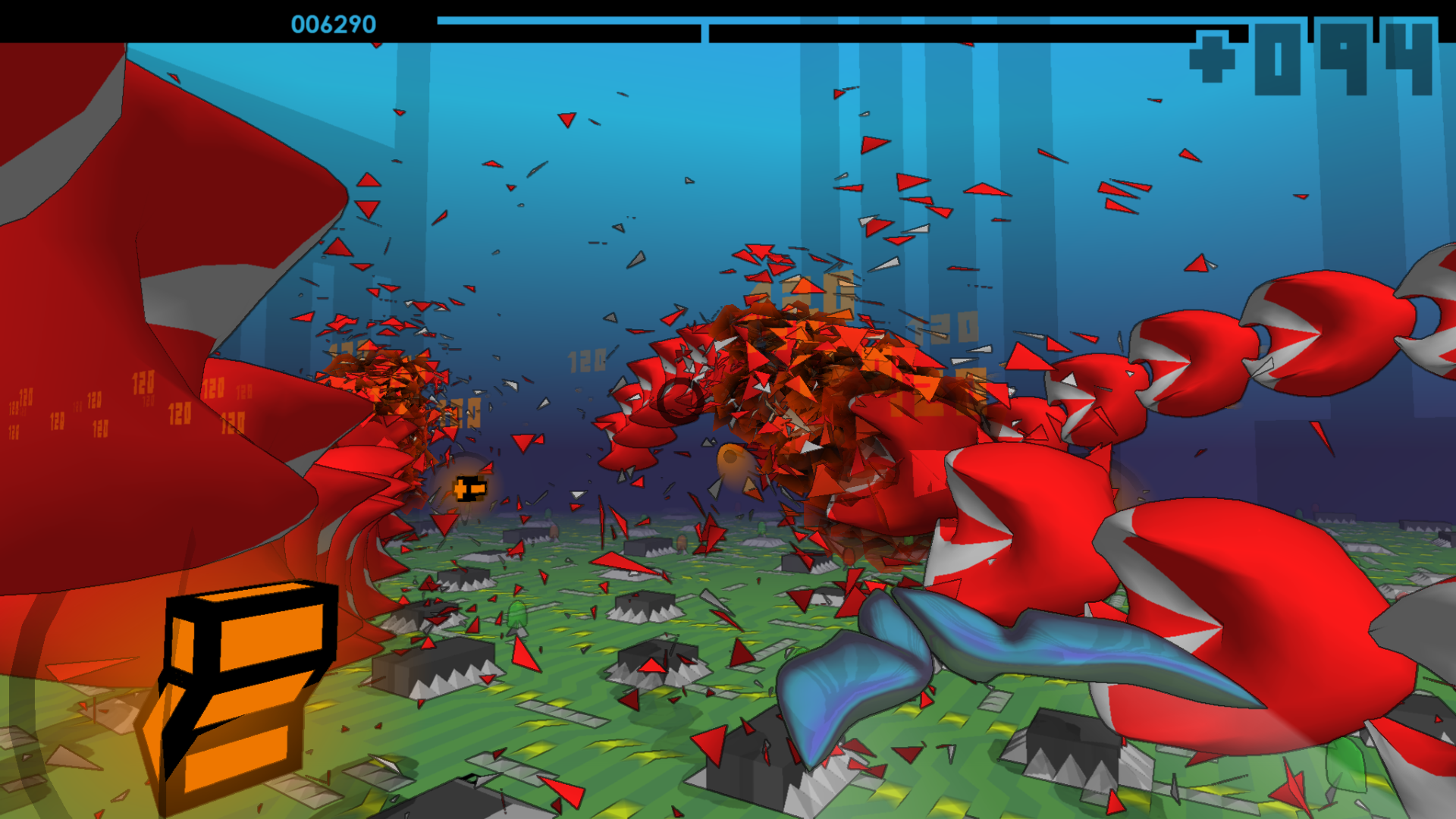
Art Style – I’ve attempted cel-shading for a second time, and with much more success. I’m keeping it!
This time I added some inked outlines to solid objects first. The flat untextured look of many of the objects in the game suddenly seemed to make a lot more sense with these in. Some objects and terrains are going to need some changes (mainly colour gradients), but the amount of work this turned out to be is quite small, and that surprised me. I’ve always felt like the look of the game was lacking something, and a temptation to add more visual detail to things was constant. But this feels like a solution and a style that suits the game. I’m happy with this!
Reticle – Aiming has always been difficult in Substream. The third person camera and flying targets made it hard to judge depth and what your ship is facing towards. I’d copied Starfox, which uses a pair of targetting rings that sit in front of the ship to give you the gist, but players struggled with this.
I had an idea for a reticle system early in the project which I’ve only just implemented, because it was tricky and I wasn’t sure if it would work. I might do a technical description later, but just know that this is a thousand times better. There is one targeting ring and it works more like a mouse pointer or first person shooter target. When you put it over a static enemy you will hit it, and leading your shots on a moving target it’s a lot easier now. I’m happy with this!
Enemies – My focus on enemies produced 11 of them. But then I decided I needed to try the targeting change, because it affects enemy design. Now that a player can hit stuff reliably, I can make enemies more dynamic and aggressive. I’m back on these now, and turning out a good variety of baddies. I’m happy with this!
October 16, 2012
I’ve seen people talking about a Financial Times article on Twitter over the last few days. It’s a unique insight; a view on game design and game culture from someone very new to games. I recommend reading it. The link is below, and the rest of this blog post gives my reaction.
“Game Theory – What happens when someone who had never played video games is chosen as a judge for some gaming awards?”
I was actually blown away by this, and I think this a major achievement.
I don’t worry a great deal about the “wider cultural acceptance” of videogames. I feel like the share of the population that are gamers is large enough and invested enough that they can feel confidence in it’s worth without outside approval. But yes, the outside view of games is very different to other popular mediums. Most people who don’t regularly read books, visit museums or watch movies still have the understanding that they can create a wide range of emotions, educations and experiences. Many people who never play games do not have that understanding.
So when a person so far from the traditional video game target-market, approaching games with that background and attitude can come away not just having gained some understanding, but some enjoyment and respect is huge. Not convinced? Try to imagine if this piece had been written in the PS2 era. Remember when “indie” wasn’t a thing, and video games could only find a market through a handful of big publishers who played it safe. When game designers repeatedly failed to pitch any ideas that strayed too far from stagnating genres. In the late nineties there was no platform to promote a game like Proteus, and no support for a game like Journey. Business models for games like this seemed impossible.
![354cpro-613x355[1]](http://www.benbradley.com/blog/wp-content/uploads/2012/10/354cpro-613x3551-300x173.png)
Proteus
Surely the same writer’s reaction to a selection from the late nineties would have been very different. Whether or not
you think there were games of artistic merit then, I think that someone with this attitude and background would not have reacted nearly as positively to the best offerings of those times. I can think of a handful of major reasons for this and some can be spotted in the article itself. It’s not my goal to go into those here, because my point is simply that these are being addressed. That’s great.
When I said “I think this a major achievement”, that doesn’t mean that I think that this article means “wider cultural acceptance” acheived. But the surface is scratched. The major achievement is that there are now games which someone who has these stereotypical negative predispositions can approach and come away from with respect and some positive insights. Obviously we still need a lot more games which do this, and do this better. Maybe we need more platforms like GameCity to set this kind of connection up. Indie games have been around for a while now; sometimes it’s good to remember the background they emerged from every now and then.
October 10, 2012
After twenty months of Substream development, running out of money, and then ten months of freelance programming, I’m working on Substream again. Going back to the spare room to work feels quite different to when I first started. A good chunk of my initial excitement and optimism are now replaced with a sober apprehension. I’ve found out how good my scheduling is: not very. But at least now I appreciate that Hofstadter’s law holds true, and scheduling a game is hard. I’ve made my revised predictions, but getting some more freelance work is a possibilty at some point.
As well as having a new philosphy, I’m approaching development quite differently too. Important things that I rushed last year I can now do justice to, and things I spent too much time with I’ve identified by taking an extended break.

Substream Test Level
So what’s my new priority? Enemies. These were the worst aspect of the game.
I’m prototyping these first, and then if I like them, creating a decent first pass for use in the game. I’m working in a test environment (see pic) and not polishing them or audio-syncing them at this stage. This is very different to how I used to make enemies; when I got to a new part of a level, I’d build an audio-synced enemy at that point, and polish it to final quality.
I’m also reevaluating all existing enemies. A few won’t change, a few will be culled, but most need work done to them of varying amounts. Enemies that float along in front of you at approximately your speed were a staple of the game; not only was this dull, but I’ve come to realise that when a player is concentrating on something that doesn’t really move relative to them, it removes some of the sense of speed.
In the past year I did a little work on the game, but I didn’t have the time or focus to see things through; and so I’d left several important things broken by the time I came back to the game. Most of the levels are totally unplayable and there are several graphics bugs. I’m not fixing these things right now. My test environment works and that’s all I need to do my current task, so the screenshot above is pretty representative of what I’m seeing throughout October.
April 6, 2012
I’m still working as a contract programmer at a games studio at the moment. I’ve been coding user interface systems in Lua for the most part. But the project itself hasn’t been publicly announced yet so I can’t go into more detail than that right now.
I’ve been working this position for six months so far and I’m currently contracted for a few more months. Eventually I will get back to working on Substream full time. I’ve been separated from it lately in a variety of ways:
- I only get an occasional weekend day to work on it.
- My graphics card recently died so I’ve had to reduce the graphics to a handful of polys to be able to run it with an old spare card.
- I started refactoring some code a few months ago and when I do get a chance to work on the game now I’m not excited by the idea of finishing that. The result being that only one level works right now.
This is really focusing the work I do into very specific places. I can’t really play the game at all, and haven’t for months!
So all my thoughts about it are at a very high level: What development practices have I been doing badly that I can improve? Why is this game taking thrice as long to make as I expected? Is that a bad thing? I know I spent a week on this bit but is it actually fun? Can I schedule my work better? What things have I focused on too much, or not enough?
High level thoughts are welcome, because it can be really hard to access them when I am focused right down on the transparency of a particle or a bug in an algorithm. I’m making lots of notes so I can remember all this in a few months when my contract ends and I’m working on Substream full time again.